


The Ferrari Testarossa: Racing’s Red-Headed Royalty
- Mike Stamp
- Sep 14, 2025
- 4 min read

Picture this: it’s the 1950s, blokes are still smoking in hospitals, Britain has three television channels, and Ferrari decides to paint some cam covers red. Not for marketing. Not for Instagram likes. Just because the Italians thought it looked fast. They christened it Testa Rossa which literally means “red head” and with that, a motorsport dynasty was born. Only Ferrari could make a dab of paint sound like an operatic masterpiece.
But don’t be fooled by the glamour of the 1980s wedge-shaped poster car or Don Johnson’s linen suits in Miami Vice. Long before the Testarossa prowled Wall Street, it was a racing weapon. A series of snarling, tyre-shredding machines that made endurance racing look as easy as a Sunday drive. Except it wasn’t. It was 24 hours of noise, danger, and the occasional fireball.
And the Testarossa thrived in it.

500 TR: The First Red-Head with Bite
Ferrari, being Ferrari, didn’t invent the Testarossa to be pretty. It was a counterpunch to Maserati in 1956. The brief was simple: “We need a new weapon.” The result was the 500 TR, powered by a 2.0-litre four-cylinder engine. Yes, a four-pot Ferrari. The sort of thing that would make modern supercar owners spill their espresso.

But this wasn’t some limp hatchback motor. It churned out 177 horsepower, which in the 1950s was enough to out-drag most of Europe’s finest. And just to make sure no one forgot it meant business, engineer Massimino painted the cam covers red. Because red equals veloce, obviously.
The 500 TR wasn’t just fast. It set the tone. It won races, it terrified Maseratis, and it gave Ferrari its first “red-head” identity.
500 TRC: Sleeker, Meaner, Faster
Ferrari didn’t stop there. In 1957 along came the 500 TRC, with more shapely coachwork by Scaglietti. Same engine, same output, but now legal under the new racing regulations. The “C” stood for “Corsa” which, translated loosely, means “please stand aside, we’re here to win.”

And win it did. The TRC took class victories at Sebring and Le Mans, proving that Ferrari’s little red-headed brute could survive the world’s most punishing endurance races. Imagine 24 hours of thrashing a car around at full tilt, with the mechanical sympathy of a toddler on a sugar rush, and the Ferrari still came out on top.
250 TR: The Red-Head Goes Nuclear
Then came the big one, the 250 Testa Rossa of 1957. This wasn’t just a car. It was Ferrari’s battering ram for global dominance. Out went the four-cylinder, in came the 3.0-litre V12 from the 250 GT, fettled with twin-choke carburettors and tuned for just under 300 horsepower.

It was beautiful, it was brutal, and it was loud enough to drown out your mother-in-law for miles. The red cam covers remained, naturally, because by now they were Ferrari’s version of a warning label: may cause competitors severe emotional distress.
The 250 TR dominated, winning the 1958 World Sportscar Championship and racking up victories at Sebring, Buenos Aires, and of course, Le Mans. Ferrari wasn’t just building cars anymore. It was writing history.
330 TRI/LM: The Last Front-Engined Champion
By the early 1960s endurance racing was changing. Mid-engined cars were starting to appear, making Ferrari’s front-engined bruisers look about as modern as a horse and cart. But Ferrari, stubborn as always, had one last trick: the 330 TRI/LM.

This was a one-off powered by a 4.0-litre V12 with 390 horsepower. They handed it to Phil Hill and Olivier Gendebien for the 1962 Le Mans. The result? Victory. The last ever front-engined car to win Le Mans. Think about that. Ferrari went out with a bang, like Sinatra walking off stage mid-song, except louder and with more explosions.
1984 Testarossa: From Track to Poster
At this point, you might be wondering where the wedge-shaped, side-straked Miami Vice supercar fits into all this racing glory. The truth is, it doesn’t really. The 1984 Ferrari Testarossa was a road car first and foremost, a successor to the 512 BBi, with a massive 4.9-litre flat-12 pumping out 385 horsepower.

It didn’t win Le Mans, but it won the 1980s. It was on every poster, every magazine cover, and every Wall Street banker’s wish list. It was also wider than most London buses and had side strakes that looked like they’d been nicked from a cheese grater. But hey, it was called Testarossa. And that name came with racing heritage baked into the metal.
The 512 TR and F512 M: Tinkering with a Legend
Ferrari being Ferrari, they couldn’t leave the Testarossa alone. Enter the 512 TR in 1991, a facelift with better aero, more comfort, and 422 horsepower. The biggest scandal? It had two wing mirrors. Apparently, seeing behind you was now fashionable.
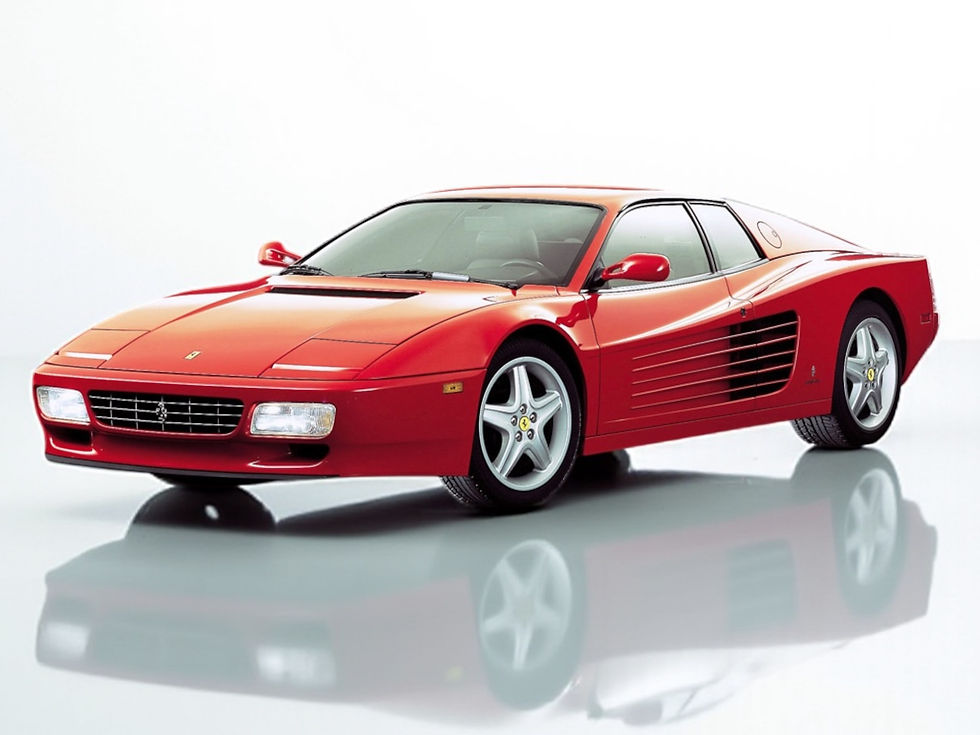
Then came the F512 M in 1994, the final evolution of the road-going Testarossa. More power (435 horsepower), tweaked styling, and horror of horrors, fixed headlights instead of pop-ups. That’s like remaking The Italian Job without Minis. It still worked, but some of the magic was gone.
The 849 Testarossa: A Red-Head Reborn
Fast forward to 2025 and Ferrari has dusted off the Testarossa badge for the 849 TR. Don’t think of this as retro pandering though. This is Ferrari’s new flagship, a 1,036-horsepower hybrid monster with a twin-turbo V8 and three electric motors. It replaces the SF90, brings chassis wizardry that borders on witchcraft, and wears the most famous Ferrari name of them all.

It’s not a Le Mans racer, but it’s every bit as extreme as the Testarossas that came before. A road car with race-car blood in its veins. And crucially, it proves that Ferrari hasn’t forgotten what made the “red-head” special in the first place: power, theatre, and just enough insanity to make you grin.
Legacy of the Red-Head
So, what have we learned? That Ferrari’s Testarossa isn’t just a car. It’s a lineage. A racing family tree painted red. From the 500 TR’s scrappy four-cylinder to the 250 TR’s V12 dominance, from Le Mans glory to 80s excess, every Testarossa carried the same DNA: engines that were equal parts brilliance and lunacy.
The 849 TR isn’t just a comeback. It’s a coronation. Proof that even in an age of hybrids and regulations, Ferrari can still conjure a machine that makes your jaw drop and your neighbours file noise complaints.
Because at the end of the day, it doesn’t matter if it’s 1958 or 2025. A Ferrari with a red head is still a Ferrari with a red head.
And that, frankly, is enough.


Comments